

Eosinophilic Esophagitis (EOE): The Truth About What’s Actually Driving Your Symptoms
Discover the triggers of Eosinophilic Esophagitis (EOE) and explore a natural, science-based approach to healing. Learn how food allergies, gut health, and immune dysfunction contribute to EOE symptoms—and how targeted testing and personalized nutrition can help reduce inflammation, improve digestion, and support long-term relief without relying solely on medications.
GUT HEALTH
Dr. Destiny Decker, D.C.
5/27/20265 min read

Eosinophilic Esophagitis (EOE)
If you’ve been diagnosed with Eosinophilic Esophagitis (EOE), you’ve probably been told one of two things:
“We don’t fully understand what causes it.”
“Let’s suppress the inflammation and manage symptoms.”
And while that may reflect the current standard of care, it doesn’t answer the most important question:
Why is your immune system reacting in the first place?
Your body is not randomly attacking your esophagus. It is responding to something.
What Is EOE?
EOE is typically described as a chronic immune-mediated condition where eosinophils accumulate in the esophageal lining.
That’s accurate—but incomplete.
Because EOE is not just about eosinophils. It is:
A type 2 (Th2) immune response
Antigen-driven
Most commonly triggered by food exposures
Understanding this changes everything, because it shifts the goal from simply suppressing inflammation to identifying what is actually driving it.
What’s Actually Happening
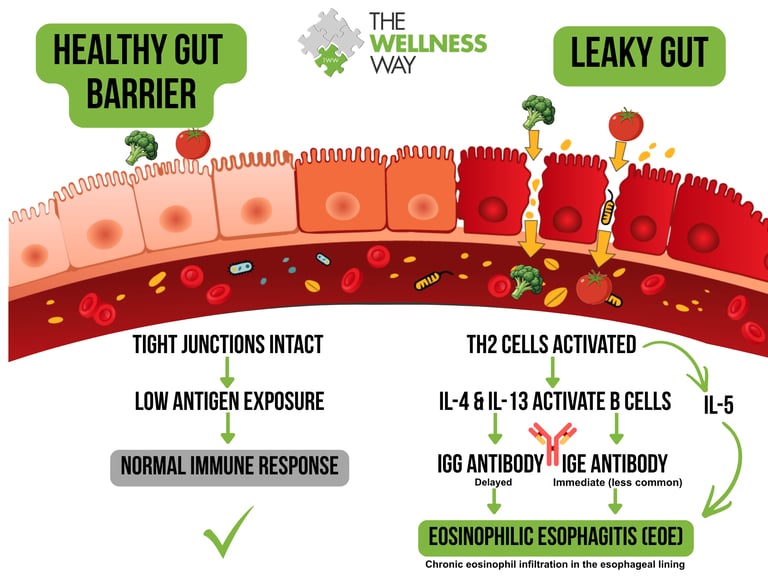
In a healthy system, when you eat food, it stays within the digestive tract, the immune system recognizes it as safe, and nothing happens.
But when the gut lining becomes inflamed or compromised, that process changes. Small food particles, known as antigens, can cross the gut barrier and interact directly with the immune system. This is where the problem begins.
The Immune Cascade
Once those antigens cross into immune territory, your body responds exactly as it was designed to.
First, food proteins interact with immune cells. Then the immune system shifts into a Th2-dominant response. From there, key signaling molecules—IL‑4, IL‑5, and IL‑13—are released.
These signals drive two processes at the same time.
Two Processes, One Trigger
Pathway 1: Inflammation (What Defines EOE)
IL‑5 and IL‑13 stimulate eosinophils, which migrate into the esophagus and create chronic inflammation. This is what defines the condition.
Pathway 2: Antibody Production (What We Can Measure)
At the same time, IL‑4 and IL‑13 stimulate B cells to produce antibodies:
IgE, associated with immediate reactions
IgG, often associated with delayed or chronic exposure
These antibodies reflect what your immune system is reacting to.
The Key Insight Most People Miss
These pathways are not separate.
The same antigen that activates the Th2 response is capable of both driving eosinophilic inflammation and stimulating antibody production.
That connection is where the conversation around food testing often breaks down.
Food Testing “Doesn’t Work”… Or Does It?
You’ll often hear that food allergy testing is not helpful in EOE. And if you are only talking about traditional IgE-based testing, that conclusion makes sense. IgE reflects immediate hypersensitivity reactions and represents only a small portion of overall immune activity.
So when studies show that IgE-guided diets are not consistently superior to broad elimination diets, the takeaway becomes that testing is not useful. But in reality, that conclusion is based on looking at an incomplete picture of the immune system.
What I See Clinically
In practice, a different pattern consistently emerges.
Many EOE patients show little to no IgE reactivity, yet they demonstrate elevated IgG responses to specific foods. At the same time, they often have underlying gut inflammation or imbalance that is contributing to how their immune system is reacting.
When those reactive foods are removed and the gut is properly supported, the changes can be significant. Patients often experience improvement in symptoms, easier swallowing, reduced inflammation, and normalization of eosinophil counts. These are not isolated cases; they are repeatable clinical patterns.
The Bigger Problem: We’re Still Guessing
Most patients are guided into either limited testing or broad elimination diets.
Elimination diets can work, but they are often highly restrictive, time-consuming, and based on trial and error. Patients remove multiple food groups, slowly reintroduce them, and repeat the process—often without ever truly understanding what is driving the reaction.
At the same time, medications aimed at suppressing the immune system may reduce inflammation, but they do not address why the immune system is reacting in the first place.
The Missing Piece: Gut Health
Food is only part of the equation. The gut environment plays a major role in how the immune system responds.
Through comprehensive stool testing, underlying issues are often uncovered, such as microbial imbalances, low levels of beneficial bacteria, elevated inflammatory markers, and signs of ongoing immune activation in the gut lining.
When the gut barrier is compromised, the immune system becomes more reactive, and even foods that would normally be tolerated can contribute to inflammation. Without addressing this environment, food removal alone may not lead to lasting improvement.
My Story
This is not just something I see clinically, it is something I have lived through.
I was diagnosed with EOE at age 19. At that time, I experienced symptoms that many patients know all too well—severe heartburn, nausea, seasonal allergies, and ongoing inflammation that felt difficult to control.
Today, I have a normal eosinophil count and no symptoms.
No difficulty swallowing.
No rashes.
No seasonal allergies.
No severe heartburn or nausea.
That change did not come from simply suppressing symptoms. It came from identifying food triggers through testing, understanding what my immune system was reacting to, and addressing the health of my gut.
That experience is what drives my passion for helping others. Because what I have seen, both personally and in practice, is that many patients are not being given the full picture or the full set of tools when it comes to managing this condition.
A More Complete Approach
When you combine both sides of the equation, the approach becomes much more precise.
This includes:
Food allergy testing that looks beyond IgE alone
Comprehensive stool analysis to evaluate gut health
Targeted support to reduce inflammation and restore balance
Strategic, data-informed removal of trigger foods
Instead of guessing, you have direction. Instead of broad restriction, you have a starting point based on how your immune system is actually responding.
The Bottom Line
Food testing doesn’t “not work.” It has simply been approached too narrowly.
When you expand the picture to include both the immune response and the condition of the gut, patterns begin to emerge that make sense both biologically and clinically.
EOE is not random. It is a response. And once you understand what your body is responding to, you can begin to address it more effectively.
What to Do Next
If you’ve been cycling through elimination diets, relying on symptom suppression, or feeling like you’re not getting clear answers, it may be time to take a more comprehensive approach.
The next step is to identify what your immune system is reacting to and evaluate what is happening within your gut. That means incorporating targeted food allergy testing and comprehensive stool analysis into your care.
This is where you move from guessing to understanding, and from managing symptoms to addressing what is actually driving the inflammation.
Click the link below to schedule a free 15-minute call with me to discuss how we can help!



Connect with us
Join us on a journey to wellness today.
leesburg@thewellnessway.com
(571) 680-1094
© 2025. All rights reserved.
Location
540 Fort evans rd Ne Suite 302 Leesburg, VA 20176